Full-arch rehabilitation on four and six implants
Whose work this is
- Clinical work by
- Independent clinicians publishing through Nobel Biocare's clinical library
- Published by
- Nobel Biocare Services AG
This page is our summary in our own words. The original material is not reproduced here.
Read the original at Nobel Biocare Services AG →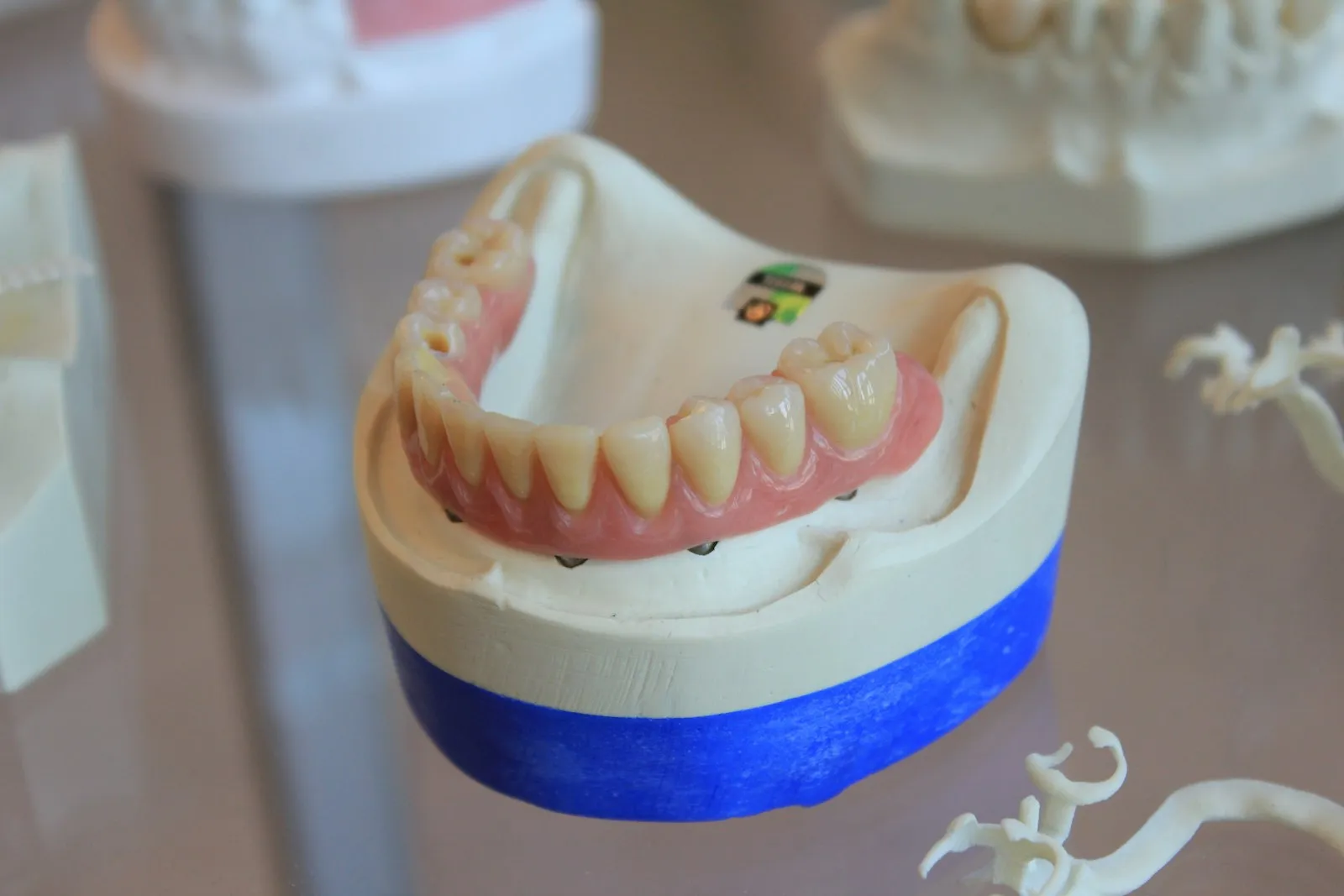
What the published material covers
Nobel Biocare defines and documents the All-on-4 treatment concept, and independent clinicians publish cases through its clinical library showing full-arch rehabilitation on four and on six implants.
As above: we summarise, we attribute, and we link. The cases belong to the clinicians who performed them.
The mechanical argument, in plain terms
A full arch of teeth is carried by a rigid bridge. The forces on it concentrate at the ends, where the bridge extends beyond the last implant — the cantilever. The longer that overhang, the more leverage acts on the implant nearest to it.
Four implants with the rear pair angled forward push those rear supports further back along the arch, shortening the cantilever without needing bone in the region where bone has usually gone. That is the idea, and it is a genuinely elegant one.
Six implants shorten the spans further and share the load between more supports. Where the bone allows it, that is mechanically the more comfortable arrangement.
Why neither is “the better option”
They solve different starting conditions. A jaw with usable bone across its length can take six. A jaw where the back has resorbed substantially cannot, and forcing two extra implants into poor bone produces supports that contribute little while complicating the whole arrangement.
Clinics that present four and six as a budget tier and a premium tier are describing their price list, not your anatomy.
The part that gets oversold
Fixed teeth on the day of surgery. It is possible, it is documented, and it is what most patients want to hear. It also depends on stability readings taken during the operation, which nobody can know in advance.
The published cases where it worked are cases where those readings supported it. They are not a promise that yours will.