Nobel Biocare S Series
The same three implant bodies, brought onto one prosthetic connection
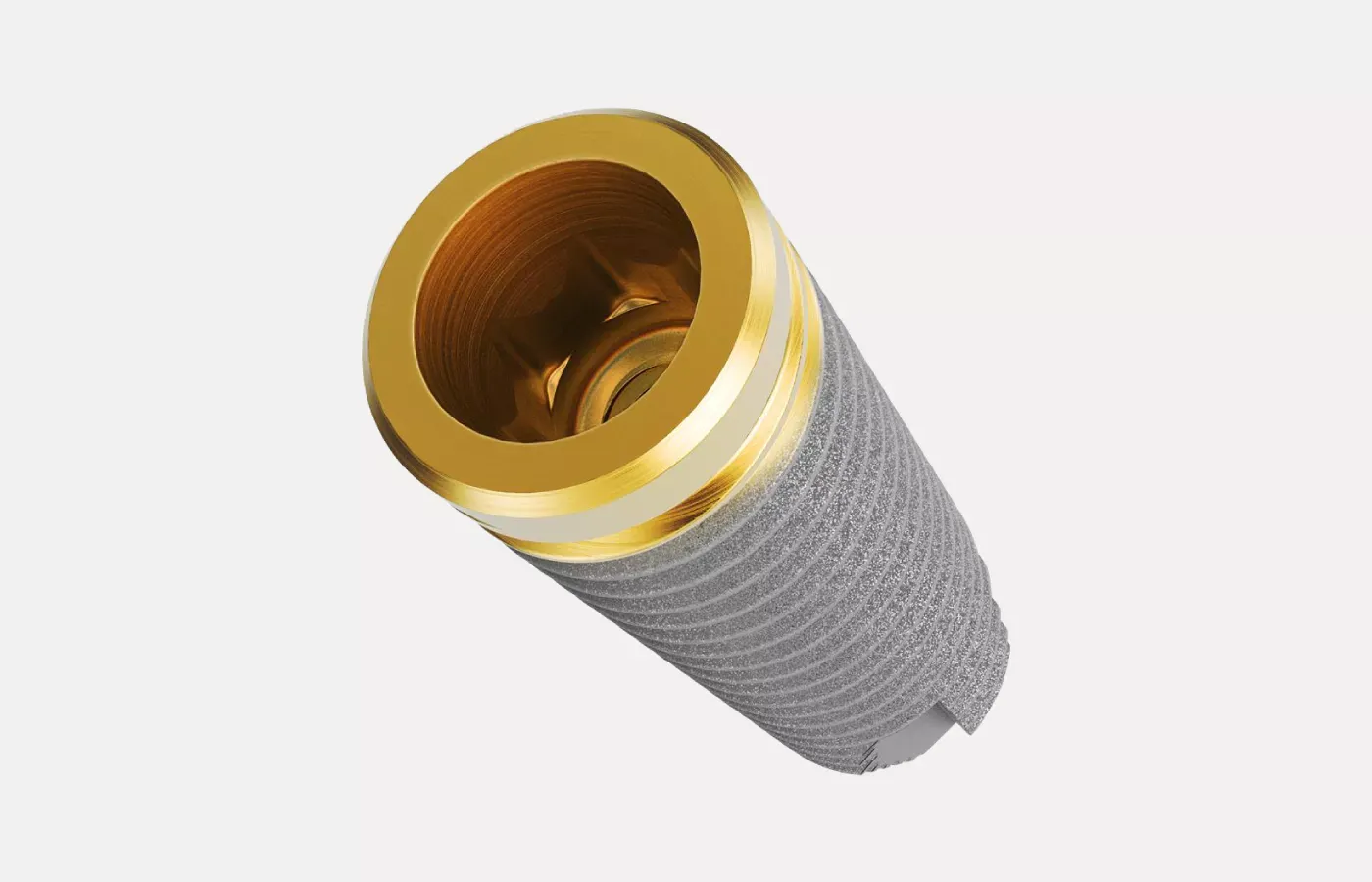
The S Series, introduced in February 2026, is not a new implant shape. It takes the three established Nobel Biocare bodies — NobelActive, NobelParallel and NobelReplace — and standardises all of them onto a single NP conical prosthetic connection, at every diameter. For a clinic that means one driver, far fewer abutment variants and simpler stock; for a patient it means the surgical reasoning is unchanged while the parts above the implant are simplified. One thing to be clear about: the long clinical record cited in its materials belongs to the implant bodies, not to the new connection, which has no long-term data of its own yet.
Clinical situations where it may be considered
- Where the body shape already fits
- The clinical indications are those of the underlying body — condensing for soft bone, parallel-walled for healed ridges, tapered for routine sites.
- Full-arch work with mixed diameters
- One connection across all diameters means a single abutment range for the whole arch, whatever diameters the bone dictated.
- Clinics standardising their inventory
- The manufacturer reports roughly a 65% reduction in Multi-unit Abutment variants — a stock and workflow argument rather than a clinical one.
- Cases where a narrow platform suits the restoration
- The single NP platform gives a greater platform shift on wider implants, which may be considered where soft-tissue thickness is a factor.
Why a clinician may select it
- The surgical protocol for the underlying body is already familiar to the team
- A single prosthetic platform removes the risk of a diameter–abutment mismatch across an arch
- Fewer component variants to stock, order and confirm before surgery
- Thicker collar wall on larger diameters, from keeping the connection narrow
- The restorative plan needs the enhanced platform shift the narrow connection produces
When another system may be selected instead
The honest caution here is about evidence rather than design. The S Series launched in February 2026, so the ten to twenty-four years of clinical experience quoted in its literature belongs to the earlier NobelActive, NobelParallel and NobelReplace implant bodies — the new connection has no long-term record of its own. Where a case calls for the longest-documented option available, the classic conical connection systems still carry that history. There is also a hard compatibility limit: per the FDA clearance, On1 Base and On1 Base Xeal must not be used with S Series implants, so a clinic built around the On1 workflow has a real reason to stay with the classic platforms.
What actually changed
Nothing about how the implants engage bone. The three bodies behave as they always have: NobelActive condenses, NobelParallel cuts a cylinder, NobelReplace follows a root form.
What changed is everything above the bone. Where the classic systems offer narrow, regular and wide prosthetic platforms — NP, RP and WP — the S Series puts one NP conical connection on every implant, at every diameter.
That sounds like a small thing and is not. Platform diameter has historically driven which abutment, which driver and which component fits, and a full arch placed with mixed diameters meant mixed prosthetic parts. One platform removes that entire class of decision.
The manufacturer reports the change reduces Multi-unit Abutment variants by roughly 65%.
Why a narrower connection on a wider implant
Counterintuitive at first: keeping the connection narrow while the implant gets wider leaves more titanium around it.
Two consequences follow. The collar wall is thicker on larger diameters, which matters mechanically at the point implants are most highly stressed. And the platform shift increases — the horizontal step between implant edge and abutment edge — which is the feature associated with keeping the connection away from crestal bone.
To keep strength in the thinner sections, the S Series uses cold-worked commercially pure Grade 4 titanium, which raises mechanical strength without alloying. High tensile strength is not the same as unbreakable: an implant loaded beyond what the plan anticipated can still fail.
The dimensions, and a detail worth catching
NobelActive S
| Diameter | Nominal lengths |
|---|---|
| 3.5 mm | 8.5 / 10 / 11.5 / 13 / 15 / 18 mm |
| 4.3 mm | 8.5 / 10 / 11.5 / 13 / 15 / 18 mm |
| 5.0 mm | 8.5 / 10 / 11.5 / 13 / 15 / 18 mm |
| 5.5 mm | 7 / 8.5 / 10 / 11.5 / 13 / 15 mm |
NobelParallel S
| Diameter | Nominal lengths |
|---|---|
| 3.75 mm | 7 / 8.5 / 10 / 11.5 / 13 / 15 / 18 mm |
| 4.3 mm | 7 / 8.5 / 10 / 11.5 / 13 / 15 / 18 mm |
| 5.0 mm | 7 / 8.5 / 10 / 11.5 / 13 / 15 / 18 mm |
| 5.5 mm | 7 / 8.5 / 10 / 11.5 / 13 / 15 mm |
NobelReplace S
| Diameter | Nominal lengths |
|---|---|
| 3.5 mm | 8 / 10 / 11.5 / 13 / 16 mm |
| 4.3 mm | 8 / 10 / 11.5 / 13 / 16 mm |
| 5.0 mm | 8 / 10 / 11.5 / 13 / 16 mm |
The detail: for NobelActive S and NobelParallel S the actual implant is about 0.5 mm shorter than its nominal name, while for NobelReplace S it is about 0.6 mm longer. Opposite directions, in the same product family.
That is roughly a millimetre of difference between two implants a clinician might treat as interchangeable, and near a nerve or a sinus floor a millimetre is not a rounding error. Surgical planning uses the dimensional drawing and the instructions for use, not the catalogue name — which is exactly the kind of specification detail this site exists to surface.
What the evidence covers, and what it does not
The S Series materials cite ten to twenty-four years of clinical experience across the three bodies. Those figures are real, and they are worth reading precisely:
- NobelActive — 97.9% mean survival across 107 studies, 22,500+ implants, 6,300+ patients
- NobelParallel — 98.7% mean survival across 29 studies, 2,800+ implants, 1,400+ patients
- Replace family — 98.4% mean survival across 130 studies, 11,900+ implants, 4,100+ patients
Each is a manufacturer aggregate across separate studies rather than one homogeneous trial, and each describes the implant body.
The S connection launched in February 2026. It has no ten-year data, because ten years have not passed. Anyone presenting the inherited figures as the S Series’ own track record is making a claim the calendar does not support.
Whether that matters depends on the case. The body going into bone is the well-documented part; the connection is a refinement of an architecture the manufacturer has been iterating for years. But it is a distinction a patient is entitled to have made, rather than discovered.
The compatibility limit
Per the FDA clearance, On1 Base and On1 Base Xeal must not be used with NobelActive S, NobelParallel S or NobelReplace S.
If a clinic has built its workflow around On1 — the base fitted at surgery and left undisturbed through the restorative phase — that workflow does not carry over. It is a genuine reason to stay with the classic platforms, and a genuine reason to ask which platform your clinic is planning.
What to ask
- Are you placing a classic or S Series implant, and why that one?
- If S Series — are you comfortable that the connection is newer than the body? A confident clinician will explain their reasoning rather than dismiss the question.
- Does my plan involve On1 components? If so, the platforms are not interchangeable.
A final diagnosis and treatment plan can only be confirmed after clinical examination and appropriate radiological assessment. Send a recent panoramic radiograph or CBCT scan and the clinical team at Taki Dent — who work with the full Nobel Biocare range — will set out which body and which platform your case points towards.