NobelParallel™ CC
The straight-walled workhorse, from one tooth to a full arch
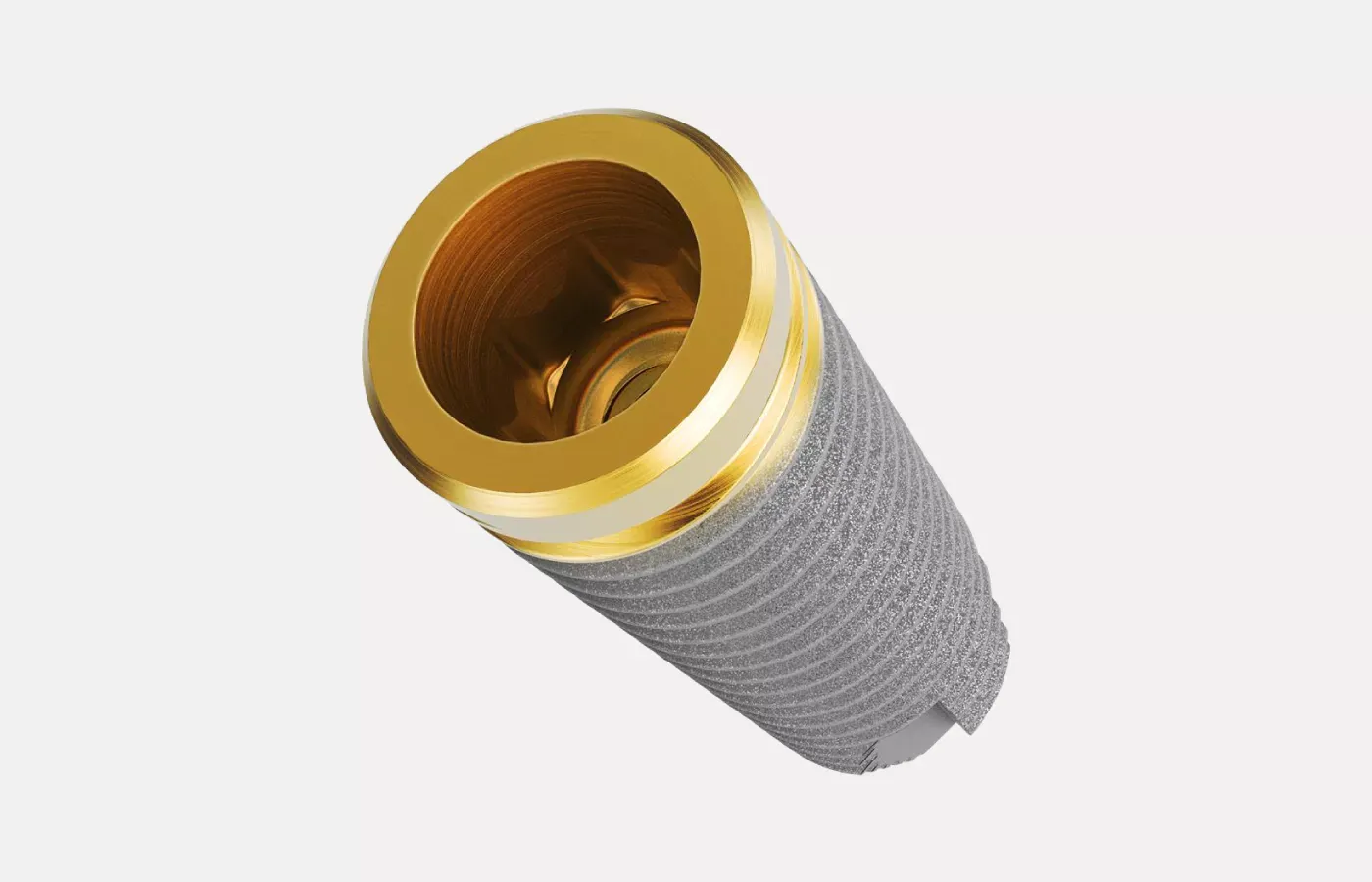
NobelParallel Conical Connection is a parallel-walled implant — the same diameter along its length, rather than tapering to a point. That shape removes less bone during preparation and is more forgiving if the prepared channel is fractionally off, which is why it is often the choice in a healed ridge of reasonable density. It carries the same conical connection as the tapered systems in the range, so the abutments and restorative components a clinician plans around are shared. Whether it suits your jaw is decided by the treating team after examination and radiological assessment.

Clinical situations where it may be considered
- Healed ridges
- Where the extraction site has healed and the bone has settled into a regular shape, a parallel-walled body may be considered.
- Regular to dense bone
- In denser bone, a condensing design offers less advantage and may generate unnecessary pressure; a straight-walled implant may be preferred.
- Multi-unit and full-arch work
- Where several implants must sit parallel to one another to carry a shared framework, a parallel body simplifies that alignment.
- Limited vertical bone
- Where the usable bone height is short, keeping full diameter to the tip may be considered so that more of the implant surface engages bone.
Why a clinician may select it
- The ridge is healed and regular, so the extra work a condensing design does is not needed
- Several implants must end up parallel to carry a bridge or full-arch framework
- Bone density is adequate, and conserving bone during preparation is the priority
- The restorative plan calls for the conical connection's abutment range
- The site sits close to an anatomical structure where a controlled, predictable preparation matters
When another system may be selected instead
Where the implant is going into a fresh extraction socket, or into soft bone in the back of the upper jaw, a tapered condensing design such as NobelActive may achieve a firmer fit on the day of surgery. Where severe upper-jaw bone loss rules out conventional implants altogether, the discussion moves to grafting, a sinus lift, or zygomatic anchorage. The system follows the anatomy.
Parallel or tapered — what the shape changes
Implants come in two broad body shapes. A tapered implant narrows towards its tip, like a natural root. A parallel-walled implant keeps its diameter all the way down. Neither is better in the abstract; they behave differently, and the jaw decides which behaviour is useful.
A tapered body compresses bone sideways as it advances. In soft bone that is an advantage, because compression is what produces a tight fit. In dense bone it is less useful and can generate more pressure on the surrounding bone than is wanted.
A parallel body cuts a cylinder and sits in it. Preparation is more predictable, less bone is removed, and if the drilled channel is fractionally misaligned the implant is more tolerant of it. Across a set of implants that must carry one framework, that predictability compounds.
Why full-arch work often favours it
When a full arch of teeth is carried on several implants, those implants have to work as a group. The framework connecting them is rigid, so their angles relative to one another matter more than they do for a single crown. Implants that sit close to parallel make the restorative work simpler and the load distribution more even.
That is a prosthetic argument, not a surgical one — and it is a good example of why implant selection is not purely about bone. The plan for the teeth influences the choice of what goes underneath them, which is why the restorative and surgical sides of the treatment are planned together rather than in sequence.
What the manufacturer reports
Nobel Biocare reports a 98.7% mean survival rate for the NobelParallel implant body across 29 clinical studies, involving more than 2,800 implants in over 1,400 patients.
As with every figure of this kind, it is an aggregate across separate studies rather than a single trial, it describes survival rather than success, and it says nothing about your particular case. It is also worth noting which NobelParallel it describes: the classic conical connection body, not the newer S Series platform, which launched in 2026 and has no long-term record of its own yet.
A smaller prospective study of 20 patients followed for 36 months reported low marginal bone loss and acceptable soft-tissue outcomes with immediately loaded NobelParallel conical connection implants. Twenty patients is a small sample; it is supportive rather than conclusive.
Surface options
Available with TiUnite or the newer TiUltra surface. A wide platform (WP) version with a 5.5 mm platform exists for posterior sites needing a broader restorative base.
Getting an answer for your own case
A treatment plan is confirmed only after clinical examination and appropriate radiological assessment. Send a recent panoramic radiograph or CBCT scan with a note on what you would like to achieve, and the clinical team at Taki Dent can review it and prepare a preliminary outline — the likely approach, the number of implants, expected visits and a cost range. The final implant system is selected by the clinical team.