NobelZygoma™
For severe upper-jaw bone loss, where conventional implants have nothing to hold
Zygomatic implants are long implants that pass through the upper jaw and anchor in the cheekbone — the zygoma. They exist for one reason: some upper jaws have lost so much bone that no conventional implant can find enough to hold, and grafting would mean a long, staged reconstruction. Anchoring in a bone that has not resorbed avoids that. This is advanced surgery with a different risk profile from routine implant treatment, and it is offered to selected patients after detailed assessment — never as a first option or a shortcut around grafting. Taki Dent performs zygomatic implant surgery; whether it applies to you is determined by examination and CBCT assessment.
Clinical situations where it may be considered
- Severe maxillary resorption
- May be considered where the upper jaw has too little bone remaining for conventional implants, with or without grafting.
- Failed previous grafting
- May be considered where earlier augmentation has not produced usable bone volume.
- Extensive sinus pneumatisation
- May be considered where the sinus has expanded into the space conventional implants would occupy.
- Full-arch upper rehabilitation
- Used as part of a fixed full-arch plan, often combined with conventional implants at the front of the jaw.
Why a clinician may select it
- CBCT shows insufficient bone in the upper jaw for conventional implants in the planned positions
- Grafting would require a long staged reconstruction the patient's circumstances do not support
- Previous augmentation has failed to produce usable bone volume
- The zygomatic bone itself is sound and offers reliable anchorage
- The prosthetic plan is a fixed full arch, and the anterior region alone cannot carry it
When another system may be selected instead
Zygomatic implants are not a way to avoid grafting for convenience. Where a sinus lift or a bone graft can produce a site suitable for conventional implants, that is usually the route with the more familiar risk profile, and it keeps the treatment within routine implant surgery. Where the lower jaw is the problem, zygomatic anchorage does not apply at all — the anatomy exists only in the upper jaw. Anyone offered zygomatic implants without a CBCT assessment and a discussion of the alternatives should ask why.
Why the cheekbone
Bone that no longer carries teeth gradually shrinks. In the upper jaw this happens alongside the maxillary sinus expanding downwards into the space the roots once occupied. After enough years without teeth, particularly for someone who has worn a full upper denture, there may be very little usable bone left across the back of the jaw.
The zygomatic bone is different. It is part of the facial skeleton rather than the tooth-bearing ridge, so it does not resorb when teeth are lost. A zygomatic implant reaches up into it and takes its support from there instead.
An honest account of the trade-off
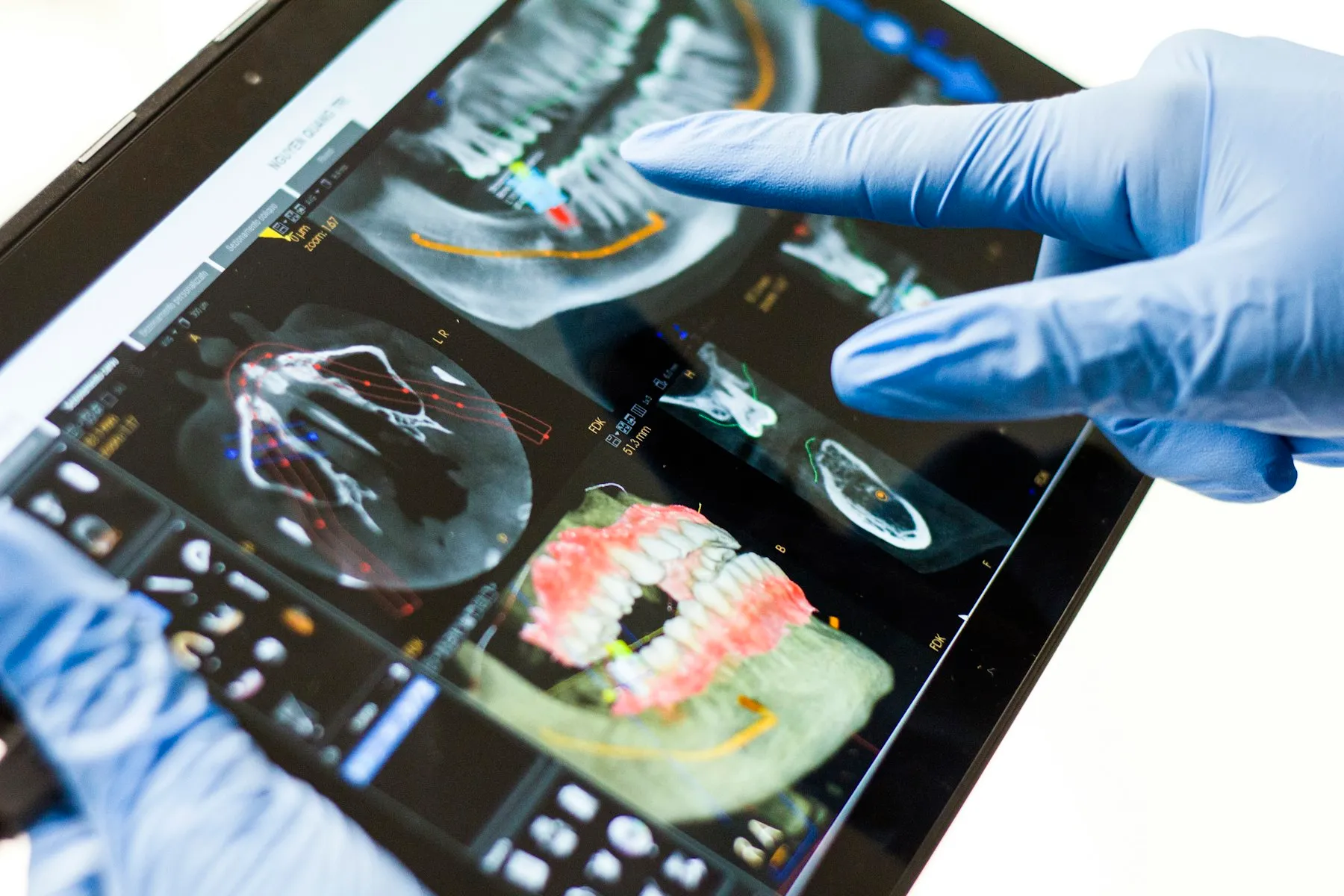
This is more demanding surgery than placing a conventional implant. The implant passes near the maxillary sinus, and the anatomy involved is close to structures where complications, though uncommon in experienced hands, are more consequential than in routine implant work. Planning requires CBCT imaging; a panoramic radiograph alone is not sufficient.
Against that: for a patient who has been told elsewhere that they have insufficient bone for implants, and whose alternative is either a long staged reconstruction or continuing with a removable denture, zygomatic anchorage can make fixed teeth possible without first rebuilding the jaw. That is a genuine option, and it is why the technique exists.
Both halves of that trade-off belong in the conversation before treatment, not after it.
Regulatory status and the evidence
The NobelZygoma TiUltra implant system received FDA 510(k) clearance as substantially equivalent on 25 August 2025, under K243834, filed by Nobel Biocare AB in Gothenburg. Clearance is not the same as FDA “approval” — it establishes substantial equivalence to an already-marketed device — but it is the correct route for this class and it is a meaningful review.
Nobel Biocare reports a 97.0% mean survival rate across 81 studies covering more than 6,500 zygomatic implants in over 2,700 patients, with maximum follow-up beyond 20 years. Different manufacturer summaries cite different figures depending on which studies and follow-up windows are selected, which is itself a reason to treat any single number carefully.
And the caveat that matters more than the number: survival and freedom from complication are not the same thing. Independent reviews consistently report high survival alongside a meaningful rate of sinusitis, oroantral communication, soft-tissue dehiscence, peri-implant inflammation and hygiene difficulty. A zygomatic implant that is still in place and has caused two episodes of sinusitis counts as a survival.
How often this is done here
Volume matters for a procedure like this, and a clinic that will not answer the question is telling you something.
Taki Dent reports 37 zygomatic implant cases during 2025, and 110 zygomatic implants placed in total. Those are figures reported by the clinic rather than published literature, and they are stated here because we ask you to put the same question to anyone else you consult.
MRI — one thing to know before you agree
The MRI safety and compatibility of configurations containing more than two zygomatic implants has not been evaluated. Heating, migration and image artefact in such configurations are not known.
A quad-zygoma rehabilitation places four. That does not make the treatment unsafe and it is not a reason to decline it — but it is something you should know in advance, carry on your record, and declare to a radiology department. There is a fuller explanation on our MRI safety page.
What happens if you send your scan
A CBCT scan is what makes this discussion concrete: it shows how much bone remains, where the sinus sits and whether the zygomatic bone offers reliable anchorage. Send your imaging with a note on your history — particularly any previous grafting or implant treatment — and the clinical team at Taki Dent can review it and set out whether zygomatic anchorage, conventional implants with augmentation, or another approach is appropriate. A final plan is confirmed only after clinical examination and radiological assessment at the clinic.