What sits on top of a Nobel implant
The abutment decides more about how your teeth look and last than the implant underneath it
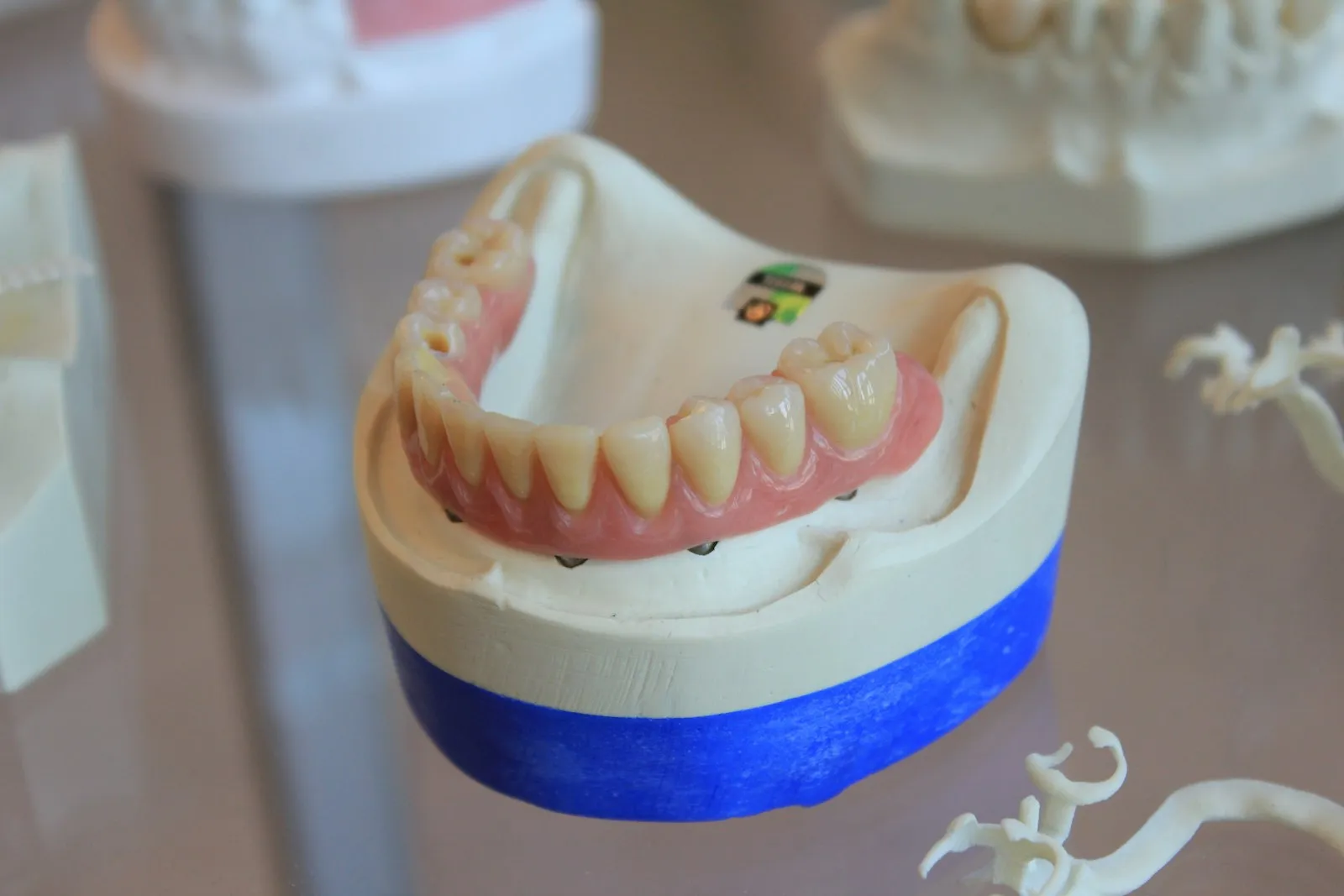
The part nobody asks about
Patients ask which implant they are getting. Almost nobody asks what goes on top of it, which is odd, because the implant is buried in bone where you will never see it and the parts above it are the ones you look at, chew with and clean around every day.
This page is about that half of the treatment.
The three layers
Every implant restoration is three things stacked on each other, and it helps to keep them apart:
- The implant — the titanium body in the bone. Chosen by your anatomy.
- The abutment — the connector between the implant and the teeth. Chosen by the restorative plan.
- The restoration — the crown, bridge or full-arch prosthesis. What you actually see.
A clinic that only ever names the first layer is describing a third of the treatment.
Multi-unit abutments — how tilted implants end up straight
This is the single most useful component to understand if you are having full-arch treatment.
In a full-arch plan the back implants are often placed at an angle — that is the whole mechanical argument of All-on-4, and it is how the back of the jaw gets support without grafting. But an angled implant points its screw channel in an angled direction, and a bridge cannot be screwed onto four screws pointing four different ways.
A multi-unit abutment solves it. Per the manufacturer, it corrects the angle, lifts the restorative platform above the soft tissue, and reduces how often the implant connection itself has to be reopened.
Three consequences that matter to you:
- Angled implants become usable. The abutment corrects what the surgery deliberately angled.
- The screw access comes out where it should — through the biting surface or behind the tooth, rather than through the front of a front tooth.
- The implant connection stays shut. Every time an abutment is removed and replaced, the seal at the bone is disturbed. Leaving the multi-unit abutment in place means the work above it can be changed without disturbing the part that matters.
Multi-unit abutments come in different angles and different collar heights. Which combination you have is worth recording, because a replacement has to match.
On1 — connecting once instead of repeatedly
On1 takes the same idea and applies it to single teeth. The base is connected during surgery and, per the manufacturer, stays in place through the restorative workflow. Impressions, provisionals and the final crown all happen above it.
The reason it exists is the same as the reason above: fewer disconnections at the implant-tissue junction.
One restriction, and it is the reason this page exists. The FDA clearance for the S Series states that On1 Base and On1 Base Xeal must not be used with S Series implants. If you have S Series implants, On1 is not a component your clinician can use with them, and any clinic proposing it has not read the clearance.
Universal Base and NobelProcera
Universal Base is the titanium link between an implant and a CAD/CAM restoration — the metal part a laboratory bonds a zirconia crown onto. It exists so that the part touching the implant is titanium regardless of what the visible tooth is made of.
NobelProcera is the manufacturer’s centralised CAD/CAM production of restorations: scanned in the clinic or laboratory, produced centrally, returned as a finished component.
Two practical things follow. Production is centralised, so replacements can be reordered against a record years later — but only if that record exists. And NobelProcera has different warranty terms from the implant itself, which is covered on the manufacturer warranty page.
Angled screw channel
A small detail with a visible consequence. In the front of the mouth, an implant is often placed at an angle dictated by the bone, which would put the screw access hole through the front surface of the tooth — the one part of a crown a patient will actually notice.
An angled screw channel redirects that access up to about 25 degrees, moving the hole behind the tooth. It is why a screw-retained crown can be used at the front rather than a cemented one, and avoiding cement matters: excess cement below the gumline is a documented cause of inflammation around implants.
What to write down
For each implant, the components are part of the record — see the implant passport:
- The abutment system and type
- For a multi-unit abutment: the angle and the collar height
- The abutment REF and LOT
- The prosthetic screw type and the torque it was tightened to
- What the final restoration is made of, and who made it
A clinic that cannot tell you the collar height of your multi-unit abutment cannot order you a matching one, and neither can anyone else.
The reasonable summary
The implant is chosen by your anatomy and the abutment by your restorative plan, and the second choice is at least as consequential as the first. It decides where the screw hole comes out, whether cement is needed, how often the implant connection is disturbed, and how straightforward a repair will be in ten years.
Ask what is going on top. It is a better question than most patients ask, and the answer tells you quickly whether the person answering has planned the whole treatment or only the surgery.