Nobel All-on-4 vs All-on-6 — what actually decides it
Four implants or six is not a budget tier and not a quality tier. It is a decision about how much usable bone you have, how hard you bite, and where the bridge has to be supported.
What this article establishes
- All-on-4 is a defined Nobel Biocare concept; All-on-6 describes a six-implant approach
- Six implants shorten the unsupported spans and share the load — where the bone allows it
- Angled rear implants are what let a four-implant plan avoid grafting the back of the jaw
First, the naming
All-on-4 is a treatment concept defined by Nobel Biocare. It has a protocol, its own components and a published body of literature. Four implants carry a full arch of fixed teeth: two placed vertically at the front, two angled at the back.
All-on-6 describes a six-implant full-arch approach. It is a general description of an arrangement, carried out here with Nobel Biocare systems, rather than a separately defined manufacturer concept.
This distinction matters when you compare quotes. Two clinics using the same words may be describing different things, and the second term in particular is used loosely across the industry.
The idea behind angling the rear implants
When teeth have been missing from the back of the jaw for years, that is where bone is most depleted — and in the upper jaw, the maxillary sinus has usually expanded downwards into the space the roots once occupied.
Placing implants straight down into that region often means grafting first: months of healing, a second procedure, more cost.
All-on-4 tilts the rear implants instead. Angled forward, they travel through bone that is still present, and they emerge further back along the arch than their entry point would suggest. The effect is a wider spread of support from fewer implants, without rebuilding the jaw first.
That is a genuinely elegant piece of engineering, and it is why the concept exists.
Why six, when six is possible
Two things change, and neither is small in a full arch.
Load sharing. The forces from chewing are considerable, and they are divided between the implants. More implants means each carries less.
Span length. The bridge sitting on top is rigid. Between supports it is unsupported, and beyond the last implant it cantilevers. The longer that overhang, the more leverage acts on the end implants — which are the ones most likely to be in the least generous bone.
Six implants shorten those spans and reduce the cantilever. Mechanically, where the bone is there to provide them, that is the more comfortable arrangement. It is often preferred for patients who grind, who have a heavy bite, or who are restoring a jaw against natural teeth rather than another denture.
Why four is sometimes the better plan anyway
Here is the part that gets sold badly.
The two extra implants have to go somewhere, with enough bone around them to be worth having. In a jaw where the posterior ridge has resorbed substantially, forcing in two more may mean placing them into poor bone — or grafting first, which is precisely what the angled arrangement was designed to avoid.
An implant in inadequate bone does not add support proportionally. It adds a component that can fail, in the region most likely to fail, while complicating the whole arrangement.
So a four-implant plan is not the budget version. It is the arrangement that suits a jaw whose usable bone sits forward. Clinics that present four and six as tiers of service are describing a price list, not your anatomy. When the team at Taki Dent proposes one over the other, the reason should be visible on your CBCT — and if it is not, ask.
What the published evidence says
The All-on-4 concept has been examined in systematic reviews and in longitudinal cohorts with 10 to 18 years of follow-up, including large series in completely edentulous mandibles and a separate cohort followed for 3 to 17 years with an analysis of risk factors.
That is a substantial body of work by the standards of implant dentistry, and it is unusual for a named concept to be studied over that horizon.
It also comes with caveats that the reviewers themselves state plainly: the evidence base is limited by methodological quality, by follow-up length, and by sample attrition, and reviewers note that peri-implant disease requires clearer definitions of what counts as success rather than mere survival.
Reading that honestly: All-on-4 is well documented, and “well documented” is not the same as “guaranteed”. A concept can have excellent published outcomes and still be the wrong choice for a particular jaw.
Where zygomatic implants come into it
Occasionally neither four nor six is possible in the usual positions, because the upper jaw has resorbed too far and the sinus has taken the space.
At that point the discussion changes: grafting and a staged reconstruction, or zygomatic implants anchored in the cheekbone, which does not resorb when teeth are lost. That is advanced surgery with a different risk profile, offered to selected patients after CBCT assessment — never as a shortcut around grafting for convenience.
Taki Dent performs zygomatic implant surgery, which is why the option is described here rather than quietly omitted. It is also why the honest version of this article has three answers rather than two.
What about teeth on the day?
Both arrangements can, in the right conditions, carry a fixed provisional bridge soon after surgery. That is what most patients are hoping to read.
The condition is stability measured during your operation. If the readings support early loading, a provisional goes on. If they do not, the implants heal first and the teeth follow — and that is a good outcome, not a setback.
Nobody can promise this in advance, because nobody has the reading in advance. A clinic that guarantees same-day teeth before seeing your jaw is guaranteeing something it cannot know.
What the day of surgery actually looks like
Patients comparing four against six rarely picture the appointment itself, and it is worth knowing, because the arrangement changes very little about your experience.
Any remaining unrestorable teeth in the arch come out at the same visit. The implants are placed under local anaesthetic, usually with sedation available. Stability is measured as each one goes in. If the readings support it, impressions or a scan are taken and a fixed provisional bridge is fitted the same day or the day after; if they do not, healing abutments go on and the arch heals covered.
Six implants take longer to place than four — meaningfully longer in surgical time, not in how the day feels to you. The recovery is broadly similar: swelling peaks a day or two afterwards, which is why booking a flight home the same evening is a bad idea regardless of which plan you are on.
The definitive bridge comes later, after integration, and that is the visit where the arrangement underneath finally stops mattering to you and the material on top starts to.
The failure modes are different, and worth knowing
This is rarely discussed and it is the most practically useful part of the comparison.
In a four-implant arch, the implants carry more load each and the cantilever at each end is longer. The failure that concerns clinicians is mechanical: screw loosening, framework fracture, or bone loss around the rear angled implant that is doing the most work.
In a six-implant arch, the load is better shared, but there are two more implants that can develop problems around them — and if two of the six were placed into marginal bone to make the number, those two are where trouble starts.
Neither is a reason to choose the other. Both are reasons to want the arrangement chosen from a scan rather than from a menu, and both are reasons to keep the review appointments afterwards.
What happens if an implant fails later
A fair question that clinics avoid, and the answer differs between the two.
Losing one implant from a six-implant arch is usually recoverable: the bridge can often be adapted to the remaining five while the site heals and a replacement is planned. Losing one from a four-implant arch is a bigger problem, because the arrangement was designed around four positions and three cannot carry the same bridge safely.
That is a genuine argument in favour of six where the bone allows it, and it is an argument about resilience rather than about quality. It is also why the clinical team at Taki Dent will lean toward six when a patient’s bone comfortably supports it, and say so plainly when it does not.
What moves the price
Not primarily the number of implants, which surprises most people.
- Extractions, where teeth remain
- Grafting or a sinus lift, if the plan needs one
- The provisional bridge — a real cost, and it should be its own line
- The material of the definitive bridge, which on a full arch is often the largest single item
- The number of visits the plan assumes
Two implants’ difference is a smaller variable than the material of the teeth sitting on them. Any estimate that separates these lines is a plan; any estimate that does not is a headline.
How to decide
You cannot, from a website — and that is the honest answer rather than a deflection.
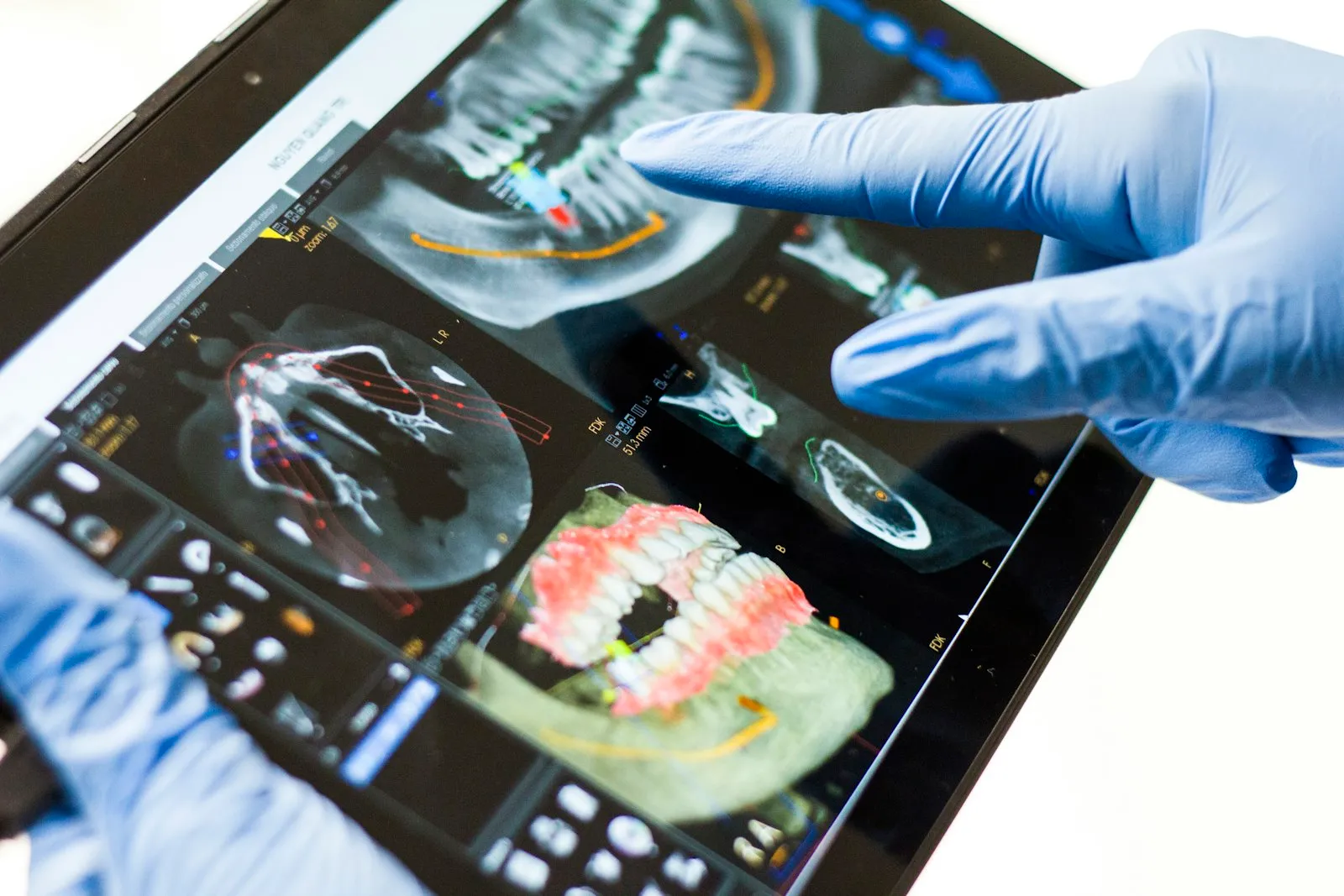
What decides it is a CBCT scan showing how much usable bone exists and where, an assessment of your bite, and a design for the finished teeth that the implant positions then have to serve. Those three things together produce a number, and the number is four or six because of them.
A final diagnosis and treatment plan can only be confirmed after clinical examination and appropriate radiological assessment. Send a recent CBCT scan — or a panoramic radiograph if that is what you have — with a note on your history and what you would like to achieve, and the clinical team at Taki Dent can set out which arrangement your anatomy supports, with a cost range attached to it.