NobelActive vs NobelParallel — which Nobel implant, and why
Two implants from the same manufacturer, sharing the same connection, designed to behave in opposite ways. Which one goes in your jaw is a decision about bone, not about which is better.

What this article establishes
- NobelActive compacts bone as it advances; NobelParallel cuts a cylinder and sits in it
- Soft bone and fresh extraction sockets favour the tapered design; healed, dense ridges do not
- Both share the conical connection, so the abutment and crown options are the same either way
The short answer, before the long one
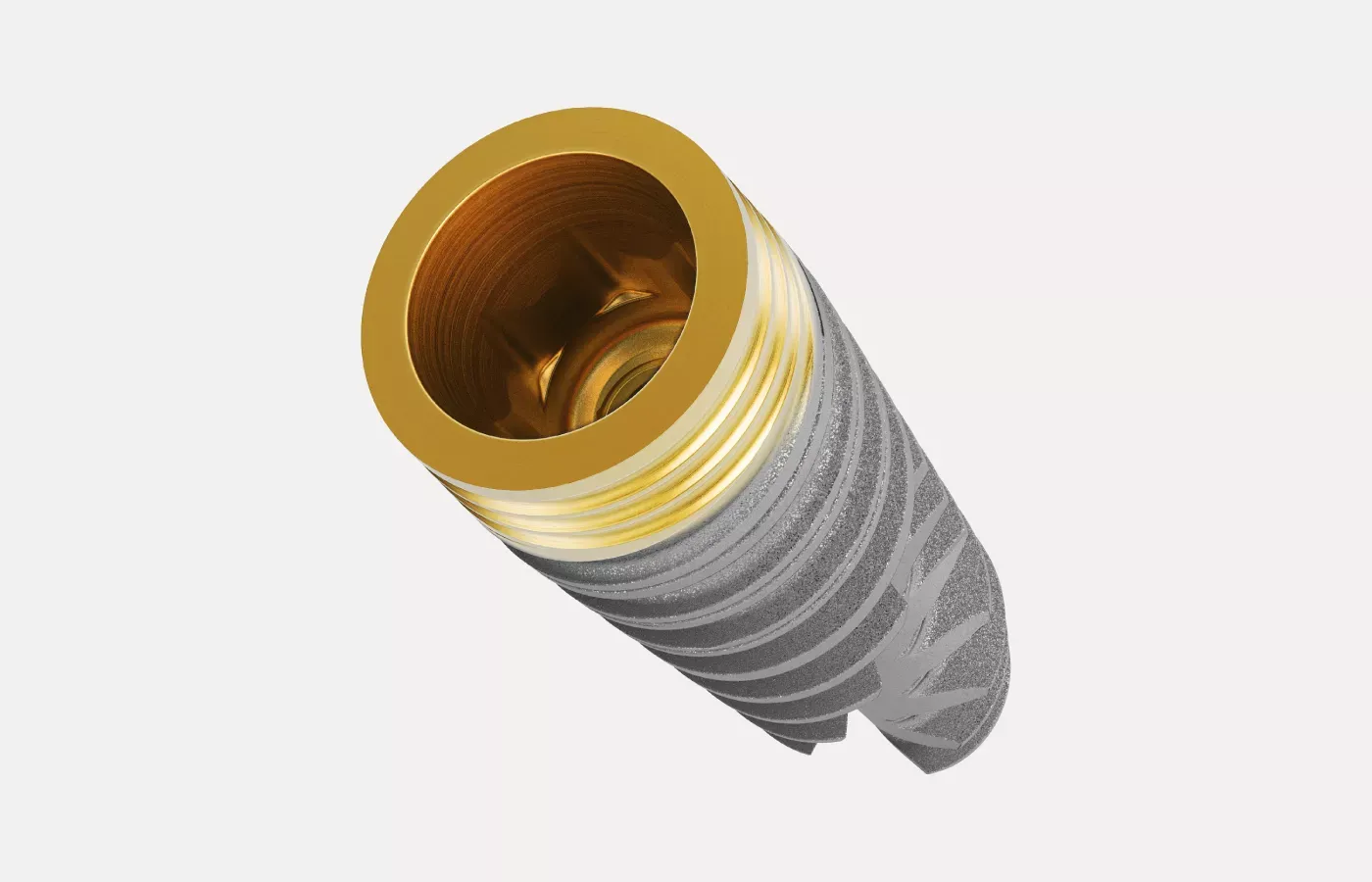
NobelActive is a tapered implant with an aggressive, condensing thread. As it is screwed into the prepared site it compacts the bone around it. NobelParallel Conical Connection is straight-walled: the same diameter from platform to tip. It cuts a cylinder and sits in it.
Neither is better. They are answers to different jaws, and a clinic that always uses one is telling you about its habits rather than about your anatomy.
Both carry the same conical connection, which matters more than most comparisons admit: the abutments, the restorative components and the prosthetic options are shared. So the choice between them is a surgical decision, not a decision about the tooth you end up with.
What the shape actually changes
Tapered and condensing
A tapered body narrows towards the tip, like a natural root. The thread design on NobelActive is described by its manufacturer as supporting high primary stability — the tightness the implant achieves on the day it is placed — including in soft bone and in selected extraction sockets.
Primary stability is not a marketing term. It is a number your surgeon reads during your operation, usually as insertion torque. It decides whether a temporary tooth can be fitted straight away or whether the implant is left to heal undisturbed. A design that reliably produces a usable reading in poor bone is solving a real problem.
The cost of that behaviour is pressure. Compaction is useful when bone is soft and unhelpful when it is already dense, where it can generate more stress on the surrounding bone than is wanted.
Parallel-walled
A straight-walled implant behaves the opposite way. Preparation is more predictable, less bone is removed, and a fractionally misaligned channel is more forgiving.
NobelParallel is positioned by the manufacturer for a broad range of indications, from single-tooth to full-arch. That breadth is not marketing filler: across a set of implants that must carry one rigid framework, predictability compounds. Implants sitting close to parallel make the restorative work simpler and spread the load more evenly.
The situations that decide it
Fresh extraction sockets
A socket is not an implant-shaped hole. It is wider at the top, tapers unevenly, and its walls may be thin or partly destroyed by whatever cost you the tooth.
An implant placed into that socket is not held by the socket — it is held by bone beyond and around it. A condensing design gives the surgeon more to work with. This is the clearest case where the tapered body earns its place, and it is why the surgical team at Taki Dent reaches for NobelActive most often in immediate cases.
Soft bone in the upper back jaw
Bone density falls off towards the back of the upper jaw. A straight-walled implant in that bone may not achieve a reading high enough to consider loading it early. Compaction can change that.
Healed, regular ridges
Where the extraction site healed years ago and the ridge is dense and generously wide, the extra work a condensing design does is not needed and the conservative option becomes the better one.
Full-arch frameworks
When four or six implants carry one bridge, their angles relative to each other matter more than they do for a single crown. Parallel walls simplify that alignment, which is a prosthetic argument rather than a surgical one — and a good illustration of why the implants and the teeth that sit on them are planned together rather than in sequence.
Bone close to a nerve or a sinus
Where the margin for error is small, a controlled, predictable preparation is worth more than a higher stability reading.
What the published evidence supports
Both designs have published clinical series behind them. For NobelActive there is a single-centre retrospective analysis of 1,001 consecutively placed implants, and a seven-year cohort of a tapered high-primary-stability implant in patients carrying local and systemic risk factors.
Those are useful studies precisely because of their design. “Consecutively placed” means the authors reported every implant in order rather than choosing the flattering ones; “with risk factors” means the harder patients were included rather than excluded.
What the literature does not contain is a trial that randomises patients between these two systems and follows them for a decade. So anyone telling you one outlasts the other is extrapolating well past the evidence. What the evidence supports is narrower and more practical: both are well-documented designs, and the interesting question is which suits the site.
The comparison that actually matters
Not NobelActive against NobelParallel. The implant against the jaw it is going into.
That comparison needs a CBCT scan. A panoramic radiograph shows bone height reasonably well and bone width not at all, and width is usually what is missing. A ridge that looks adequate on a panoramic can turn out to be a knife-edge a few millimetres across — and that single measurement changes both the system and the plan.
It is the most common reason a quote given online turns out to be incomplete once a patient is in the chair. It is also entirely avoidable: get the scan first, and the plan you are quoted is the plan you receive.
What the two share, and why it matters more than the difference
Both carry the same conical connection. That single fact resolves a worry patients often bring to this comparison: whichever goes in, the abutments, the restorative components and the prosthetic options available to you are the same, and so is the range of parts a dentist could source in ten years.
It also means a clinic can mix them within one treatment plan without creating a components problem. In a full-arch case it is entirely normal to place a condensing implant where the bone is soft and a parallel-walled one where it is dense, in the same arch, on the same day. The bridge does not know or care.
If you are comparing quotes and one clinic proposes a single system for every position in your jaw while another proposes a mix, the second is not being inconsistent. It is more likely reading the scan.
Surface, thread and body are three separate decisions
The comparison is usually framed as one choice, and it is really three.
The body shape — tapered or parallel — is the one this article has been about, and it is decided by the bone and the socket.
The thread design governs how the implant engages that bone as it advances. Aggressive threads cut and compact; finer threads engage more gently over more surface.
The surface treatment is a separate variable again, governing how bone cells attach to the implant once it is in place. It is invisible in every comparison photograph and it is part of why two implants that look similar do not behave identically.
A clinician choosing between systems is weighing all three against your site. A patient choosing between systems from a website is weighing the first one, which is why the honest advice is to bring the scan and let the argument be made against real measurements.
Questions worth asking your clinic
- Which system are you planning, and what about my scan led you there? A specific answer is a good sign. “We use the best implants” is not an answer.
- What would make you change your mind during surgery? Every honest plan has a branch in it.
- Is the plan for the teeth agreed before the implants go in? If the restorative side is being worked out afterwards, the implant positions were chosen without knowing what they had to carry.
- Which system would you choose if the socket walls turn out to be damaged? This tests whether there is a plan B at all.
At Taki Dent the surgical and restorative sides are planned together — the oral and maxillofacial surgeon who places the implants and the prosthodontist who restores them work from the finished teeth backwards. That is ordinary in careful implant dentistry, and noticeably less common in clinics that market on price.
A note on how this comparison is usually sold
Search for this comparison and you will find two kinds of page.
The first says one system is simply better, usually the one the clinic writing the page happens to stock. That claim cannot be supported: no trial randomises patients between these two designs and follows them long enough to answer it, and the manufacturer that makes both has no incentive to frame one as inferior.
The second lists specifications side by side — thread pitch, connection type, available diameters — without ever saying what any of it means for a patient. It reads as rigorous and tells you nothing you can act on.
What is actually useful sits between the two: the behaviour of each design, the situations that favour one, and the honest statement that your scan decides it. That is what a clinician’s reasoning sounds like, and it is deliberately what this page tries to reproduce.
So which one?
If your site is a fresh socket, or the bone at the back of your upper jaw is soft, the tapered condensing design is the likelier choice. If your ridge is healed and dense, or several implants must line up under one bridge, the parallel-walled system probably is.
But that is a guess made from a page, and the whole argument of this article is that guesses are what a scan replaces. The final implant system is selected by the clinical team after examination and appropriate radiological assessment.
Send a recent panoramic radiograph or CBCT scan with a note on what you would like to achieve, and the clinical team at Taki Dent can tell you which system your own anatomy points towards — and, more usefully, why.