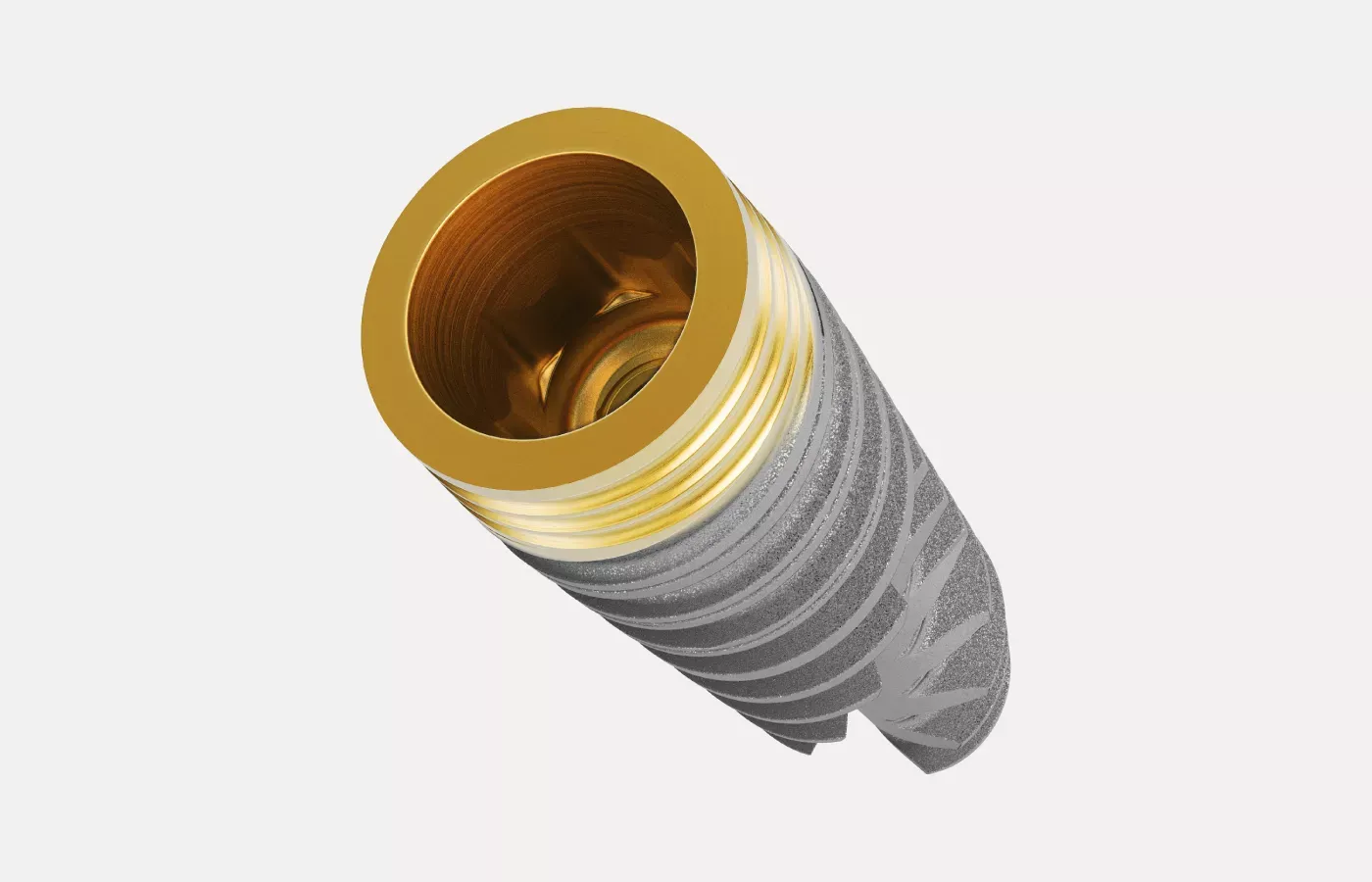
TiUltra and Xeal explained — what implant surfaces actually do
Surface technology is the least visible part of an implant and the most heavily marketed. Here is what it genuinely governs, and how much of your outcome it decides.
What this article establishes
- The surface controls how tissue attaches — bone below the gum line, soft tissue above it
- Two implants that look identical can behave differently because of it
- It is a real engineering variable and it is not where your outcome is decided
Why an implant has a surface at all
An implant is not glued into bone. It is held by bone growing directly onto its surface — osseointegration — and that process happens at a scale far smaller than anything you can see.
A perfectly smooth titanium cylinder integrates poorly. Bone cells need texture to attach to, and the way that texture is created, at what roughness, with what chemistry, is the field that surface technology occupies.
So the surface is not decoration and not marketing invention. It is the interface where the entire treatment either works or does not.
Two different jobs, above and below the gum
Here is the distinction most explanations skip, and it is the one that makes the topic make sense.
An implant sits partly in bone and partly emerging through soft tissue. Those two regions need opposite things.
Below the gum line, in bone, you want the surface to encourage bone cells to attach and mineralise against it. Roughness helps. Chemistry helps.
At and above the gum line, you want the opposite: soft tissue to seal against the surface, and bacteria not to colonise it. A rough surface exposed to the mouth is a liability rather than an asset, because it gives plaque somewhere to live.
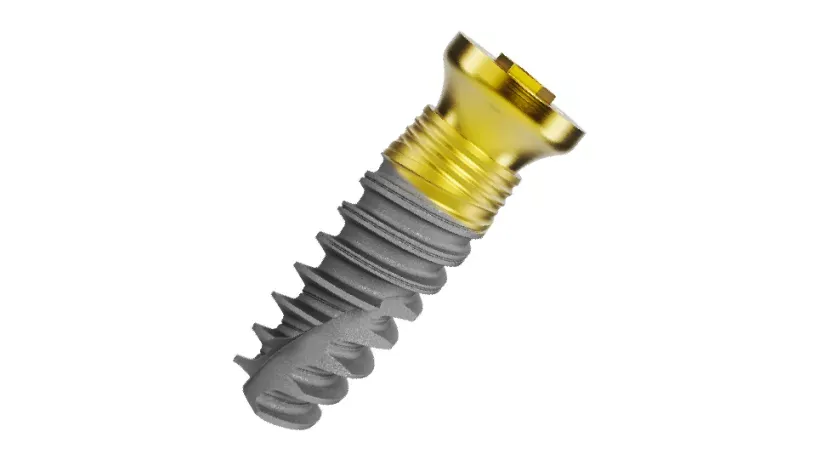
This is why modern implants are not uniformly surfaced along their length, and why abutment surfaces are engineered separately from fixture surfaces. TiUltra is Nobel Biocare’s surface technology for the implant itself; Xeal is the corresponding anodised surface for the abutment — the part that meets soft tissue. Different problem, different answer.
Once you know that, the naming stops sounding like branding and starts sounding like a description of two components with two jobs.
What this means for peri-implantitis
The reason the soft-tissue side receives so much engineering attention is peri-implantitis — inflammation and progressive bone loss around an implant, driven by bacterial colonisation.
It is the most common long-term problem in implant dentistry, and it starts at the top, where the implant meets the gum. A better soft-tissue seal is not a cosmetic refinement; it is an attempt to address the failure mode that actually causes late losses.
What it is not is a substitute for cleaning. No surface prevents peri-implantitis in an implant nobody brushes and nobody reviews. Implants need daily cleaning, the right tools to clean under a bridge, and professional review at intervals the clinical team sets — and that remains true whatever the surface.
Where the surface fits into a system
Surface treatment is one of three separate engineering decisions in any implant, and comparisons usually collapse them into one.
Body shape — tapered or parallel-walled — decides how the implant behaves as it is placed, and whether it achieves stability in the bone you have.
Thread design governs how it engages bone during insertion.
Surface governs what happens afterwards, once it is in position.
A system that treats all three as a designed whole is what Nobel Biocare means when it describes N1 as a complete system — a dedicated site-preparation protocol, a specific implant body and matching restorative components — rather than a fixture that drops into an existing workflow.
How much weight should a patient give it?
Less than the marketing implies, and more than zero.
The surface is a real variable, engineered seriously, and it is part of why two implants that look similar in a photograph do not behave the same way. It also sits well below several other factors in deciding your outcome:
- whether the site was properly assessed on a CBCT scan
- whether the implant was placed in the right position for the tooth that must sit on it
- whether the loading decision was made on a measured reading
- whether you smoke
- whether anyone reviews it in the years afterwards
If a clinic’s argument for its choice of implant rests mainly on the surface, it is leading with the least decisive point available. If a clinic cannot say anything about it at all, that is also informative.
The reasonable middle is what you would hear from the team at Taki Dent if you asked: the surface is a reason to prefer an established manufacturer over an unknown one, and it is not a reason to prefer one established manufacturer over another.
How a surface is actually made
Worth knowing roughly, because it explains why this is engineering rather than coating.
Titanium is naturally covered by a thin oxide layer the moment it meets air — that layer, not the metal underneath, is what your body actually contacts. Surface technology is largely the business of controlling that oxide: its thickness, its texture, its porosity and its chemistry.
Historically this was done by blasting the surface with particles and etching it with acid to create roughness at the scale bone cells respond to. Anodising — passing current through the implant in an electrolyte — grows and modifies the oxide layer directly, and allows different properties along the implant’s length rather than one texture everywhere.
That last point is the practically significant one. It is what lets a single component be optimised for bone at its lower portion and for soft tissue at its collar, instead of compromising between the two.
None of this is exotic materials science. It is careful process control, applied to a layer a few nanometres to a few micrometres thick, and it is the reason implants from serious manufacturers cost what they do relative to unbranded copies with a similar shape.
Why the copies are not the same implant
This is where surface technology becomes a practical consumer issue rather than a technical curiosity.
An implant can be copied dimensionally with reasonable ease — the thread form, the connection, the diameters. What is far harder to copy is the surface, because it is the output of a controlled manufacturing process rather than a shape, and it is invisible in the product photograph you are being shown.
So a “compatible” implant that looks identical, fits the same abutments and costs a fraction may differ in exactly the property that governs whether bone attaches to it well. It may also be excellent. The difficulty is that you cannot tell from the outside, and neither can your dentist without the manufacturer’s data.
That is the honest argument for an established manufacturer, and it is a narrower argument than “premium is better”: you are paying for a documented, consistently produced surface with published work behind it, rather than for a shape.
What surfaces do not do
Three claims that attach themselves to surface technology and do not survive scrutiny.
They do not eliminate healing time. Bone integrates on a biological schedule. Surface chemistry influences how readily cells attach at the start, and it does not compress months into weeks. A clinic citing a surface as the reason you can be loaded immediately has substituted a product for a measurement — the measurement being the stability reading taken during your surgery.
They do not prevent peri-implantitis. A better soft-tissue seal makes colonisation harder. It does not make an unbrushed implant safe, and it does not replace review appointments.
They do not rescue a poorly positioned implant. If an implant sits where the bone was convenient rather than where the tooth needs to be, the resulting forces are wrong regardless of what the surface is doing at the microscopic level.
Surface technology is a genuine field doing genuine work at the interface. Every one of the claims above attaches it to outcomes it does not control.
What a patient can reasonably conclude
Three things:
The surface is real and it matters. It is where integration succeeds or fails, and it is engineered separately for the two very different environments the implant lives in.
It is not your biggest variable. Position, loading decision, smoking and maintenance all outrank it. An excellently surfaced implant in the wrong position, loaded too early, in a smoker who never returns for review, will do worse than an ordinary one placed and cared for well.
It is a reason to prefer documentation over price. Not a reason to prefer one well-documented manufacturer over another.
How to check any of this independently
You do not have to take a manufacturer’s description — or this page — on trust.
Independent implant references publish manufacturer profiles and plain-English explanations of what regulatory clearances mean: FDA 510(k) clearance, CE marking under the EU medical device regime, and manufacturing to ISO 13485. Those are the standards that govern what a surface claim has to be supported by before it can be sold.
Reading a specification against an independent source is a reasonable thing to do before surgery, and it is the reason those references are linked from every system page here rather than kept out of sight.
The short version
The surface is where bone meets metal, and where gum meets metal, and those are two different engineering problems with two different solutions. It matters. It is well below the surgeon, the scan, the position and the maintenance in deciding what happens to your implant.
A final diagnosis and treatment plan can only be confirmed after clinical examination and appropriate radiological assessment. If you want the parts of this that apply to your own case, send a recent panoramic radiograph or CBCT scan and the clinical team at Taki Dent will set out which system is being proposed for you, and why.